Beaudet Reservoir Restoration – Raw Water Reservoir Waterproofing
Project
For more than 40 years, the Beaudet Reservoir has provided a source of raw water to meet the needs of the Municipality of Victoriaville. To ensure its long-term sustainability and to control sources of contamination—both organic and toxic—a restoration project has now become necessary.
The restoration project is carried out in four phases, the first of which involves the development of a new water storage reservoir. This phase includes waterproofing the reservoir bottom, the banks at the intersection of Pierre-Roux Ouest Boulevard and Route de la Grande-Ligne, as well as the primary and secondary dikes.
Challenge
In addition to resisting toxic products such as hydrocarbons and organic contaminants, the waterproofing solution must adapt to several challenging installation conditions:
- Part of the installation must be carried out underwater;
- The dikes and banks feature steep slopes, up to 2H:1V;
- A connection must be made to a concrete pumping station at the bottom of the reservoir;
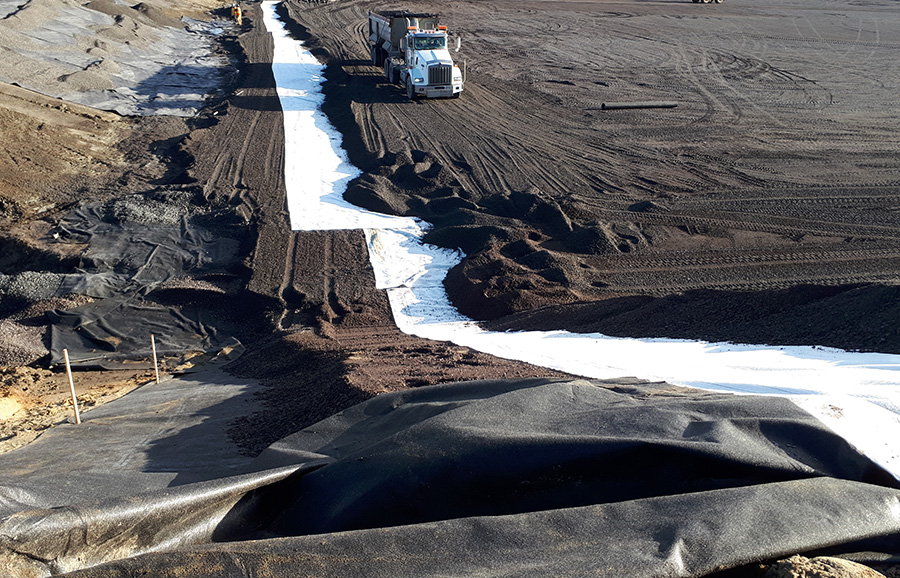
- Truck and heavy equipment traffic on the reservoir floor during construction.
Selected design concept
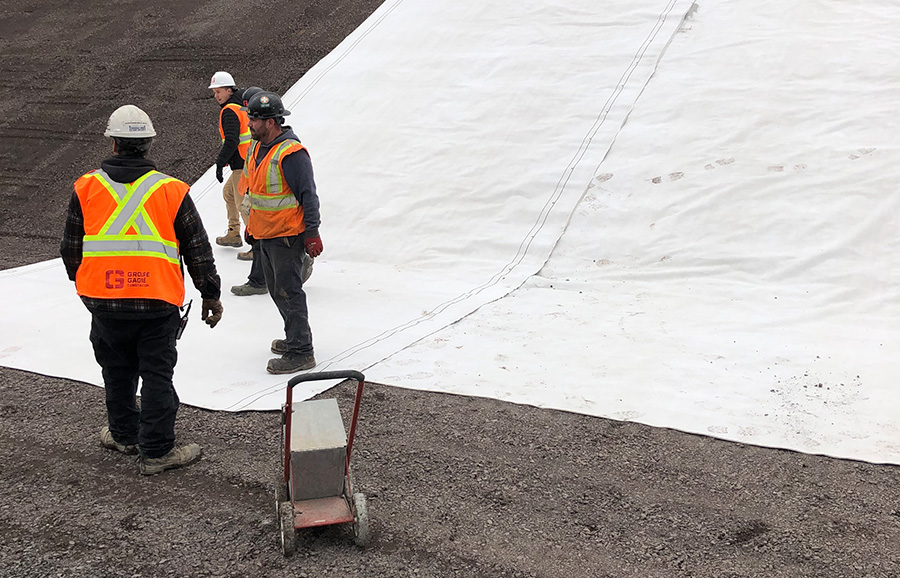
Among a wide range of waterproofing solutions, the selected option was the Texel TM600 bentonite geomembrane. This geomembrane is a geocomposite consisting of two geotextiles enclosing a uniform core of montmorillonite bentonite clay granules. The assembly is needle-punched and subjected to a unique thermal bonding process known as Thermal Lock®.
To optimally address the various constraints of the project, two types of bentonite geomembranes were used:
- Texel TM600 SRNW, for waterproofing the reservoir bottom. This geomembrane is manufactured using a combination of a nonwoven geotextile and a nonwoven geotextile reinforced with a woven layer.
- Texel TM600 CSRNW, for waterproofing steep slopes. This geomembrane is manufactured using a combination of a nonwoven geotextile and a nonwoven geotextile reinforced with a woven layer and encapsulated with a polypropylene film.
Benefits
- With a permeability on the order of 10⁻⁹ cm/s, the bentonite geomembrane also provides an excellent barrier against hydrocarbons.
- In addition, certain models such as the SRNW are manufactured with a reinforced woven geotextile in the bottom layer, which increases internal shear strength, thereby offering improved protection against stresses applied during underwater installation.
- For enhanced performance, the bottom layer made of reinforced nonwoven geotextile can be encapsulated with a polypropylene film, as in the CSRNW model. This addition provides superior resistance to delamination, allowing the waterproofing of very steep slopes, such as 2H:1V, while further reducing permeability to the order of 10⁻¹³ cm/s.
- Installation of the Texel TM600 geomembrane can be carried out by the general contractor without the need for a specialized installation crew.
All of these benefits result in cost savings as well as reduced installation time.

| Project summary | |
|---|---|
| Products | Texel TM600 SRNW et Texel TM600 CSRNW |
| Quantity | 45 000 m² |
| Application | Raw water reservoir waterproofing |
| Design | EXP Services |
| Construction | Groupe Gagné Construction |
| Owner | Municipality of Victoriaville |
| Year | 2021-2022 |