Service life extension of rail switches using a geosynthetic solution
Project
As part of its annual railway network maintenance program, the Port of Montréal must replace several rail switches due to wear and to correct their profile. This year, with the objective of extending the maintenance interval of a switch by five years, the replacement project for switch 1-63-O included the installation of geosynthetics to mitigate the impact (hammering effect) caused by the switch crossing frog.
Challenge
Train impacts at rail joints are a major factor contributing to wear. As train wheels pass over the rail gap, they generate a hammering effect not only on the rail itself, but also on the ballast and the foundation supporting the railway infrastructure. The hammering effect generated by the crossing frog leads to ballast dispersion, increases contamination of the ballast layers through the upward migration of fine particles, and creates geometry defects in the track profile at switch locations.
Interventions to replace these switches require shutting down rail traffic in order to replace components and renew a 150 to 250 mm layer of ballast (20–40 mm). With more than 130 switches across its network, the Port seeks to reduce the frequency of this type of maintenance work.

Selected design concept
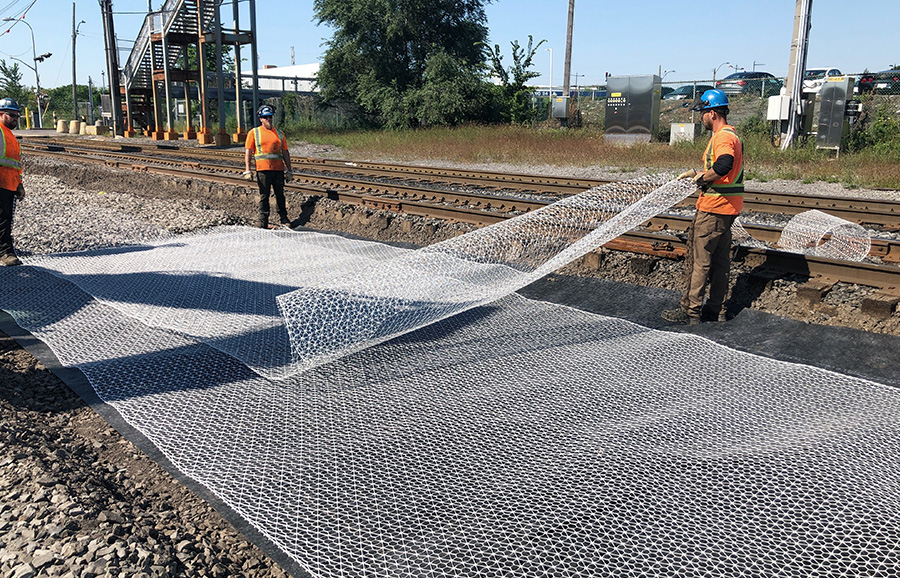
The Port of Montréal is testing the use of a fine, soft soil stabilization geotextile—Texel Geo-9 R2—combined with a high-performance geogrid, the Texel NX750 manufactured by Tensar. In addition, these products are paired with the elimination of all mechanical rail joints through aluminothermic welding within the switch.
During the work, a 150 mm layer of granular material is removed beneath the wooden ties, and the track profile is raised by a minimum of 75 mm. The primary objectives are to increase the bearing capacity of the ballast and to reduce the upward migration of fine particles within the ballast.
Texel Geo-9 R2 is a 100% polypropylene reinforcement geocomposite produced by needle-punching two geotextiles (a nonwoven combined with a woven). This product combines the properties of both technologies to optimize reinforcement, separation, filtration, and drainage performance.
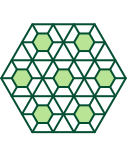
The Texel NX750 geogrid, manufactured by Tensar, is a co-extruded geogrid made from a high-strength polypropylene core coated with a compressible polymer. This geogrid is distinguished by apertures featuring a new geometry formed by a suspended hexagonal core, incorporating triangular and trapezoidal openings.
Benefits
The use of Texel Geo-9 R2 and Texel NX750 is expected to provide the following benefits:
-
- Stabilization and reinforcement of the ballast;
- Separation of fine particles to prevent their upward migration;
- Extension of the service life of the crossing frog and switch by 5 years;
- Reduced downtime for maintenance and repairs;
- Improved ride quality along the rails.

| Project summary | |
|---|---|
| Adapted Product | Texel Géo-9 R2 – Texel NX750 |
| Application | Reinforcement and separation beneath a crossing frog |
| Year of completion | 2022 |